

What Is a Safe System Approach?
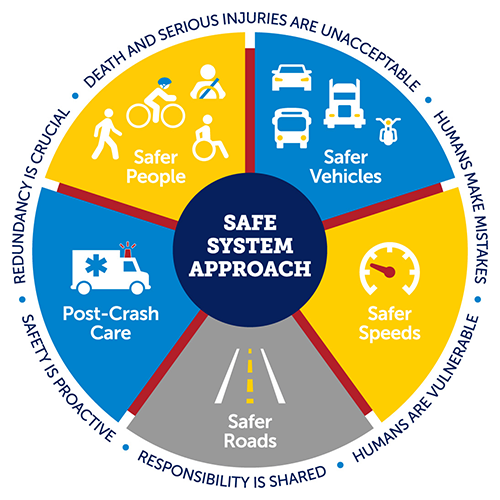
The Safe System Approach has been embraced by the transportation community as an effective way to address and mitigate the risks inherent in our enormous and complex transportation system. It works by building and reinforcing multiple layers of protection to both prevent crashes from happening in the first place and minimize the harm caused to those involved when crashes do occur. It is a holistic and comprehensive approach that provides a guiding framework to make places safer for people.
This is a shift from a conventional safety approach because it focuses on both human mistakes AND human vulnerability and designs a system with many redundancies in place to protect everyone.
U.S. DOT's National Roadway Safety Strategy and the Department’s ongoing safety programs are working towards a future with zero roadway fatalities and serious injuries. In support of this approach, safety programs are focused on infrastructure, human behavior, responsible oversight of the vehicle and transportation industry, and emergency response.
Principles of a Safe System Approach
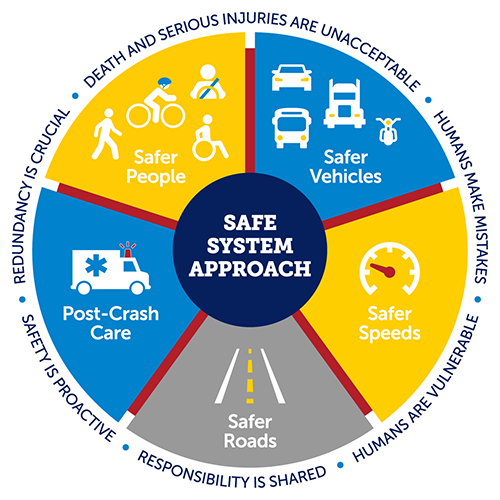 A Safe System Approach incorporates the following principles:
Death and Serious Injuries are Unacceptable
A Safe System Approach prioritizes the elimination of crashes that result in death and serious injuries.
Humans Make Mistakes
People will inevitably make mistakes and decisions that can lead or contribute to crashes, but the transportation system can be designed and operated to accommodate certain types and levels of human mistakes, and avoid death and serious injuries when a crash occurs.
Humans Are Vulnerable
Human bodies have physical limits for tolerating crash forces before death or serious injury occurs; therefore, it is critical to design and operate a transportation system that is human-centric and accommodates physical human vulnerabilities.
Responsibility is Shared
All stakeholders—including government at all levels, industry, non-profit/advocacy, researchers, and the general public—are vital to preventing fatalities and serious injuries on our roadways.
Safety is Proactive
Proactive tools should be used to identify and address safety issues in the transportation system, rather than waiting for crashes to occur and reacting afterwards.
Redundancy is Crucial
Reducing risks requires that all parts of the transportation system be strengthened, so that if one part fails, the other parts still protect people.